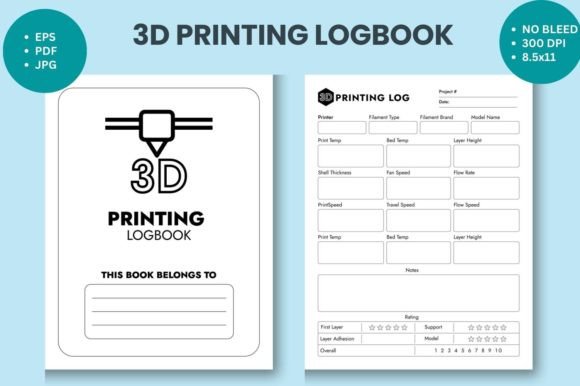
3D Printing Log Book Kdp Interior: The Operational Backbone for Professional Additive Manufacturing
In the rapidly evolving landscape of additive manufacturing, the gap between a creative concept and a finished, high-quality product often hinges on data management. Whether you are an engineer iterating on a prototype, a small business owner fulfilling custom orders, or a hobbyist refining their slicing settings, the margin for error is shrinking. This is where a 3D Printing Log Book Kdp Interior transitions from a simple notebook to a critical component of your production workflow. It serves as the central repository for the granular details that determine success in print projects.
The modern 3D printing environment is not merely about pushing a button and waiting for a layer to build. It involves complex variables including filament type, nozzle temperature, bed adhesion strategies, infill density, and post-processing techniques. Without a structured method to record these parameters, valuable insights are lost. A dedicated logbook designed specifically for this purpose ensures that every print attempt contributes to a growing library of knowledge, allowing users to replicate successes and systematically troubleshoot failures.
Integrating the Logbook into the Pre-Production Phase
Effective project management begins before the printer even powers on. The 3D Printing Log Book Kdp Interior functions as a planning tool that forces the user to define the scope and requirements of a job prior to execution. For professionals managing multiple client requests or educators guiding students through design challenges, this pre-print documentation is essential for quality control.
When initiating a new project, the logbook provides a structured space to outline the intended outcome. Users can document the specific 3D model file being used, the chosen material (such as PLA, PETG, TPU, or ABS), and the theoretical settings derived from slicer software. By recording these baseline expectations, the operator creates a "control group" against which actual results can be measured. This preparation phase reduces cognitive load during the print, as the operator has already committed their plan to paper, minimizing the risk of mid-job confusion.
This approach is particularly vital for businesses relying on consistency. When a client orders a batch of identical parts, the ability to reference previous successful logs ensures that the second run matches the first perfectly. The logbook acts as a bridge between digital design files and physical reality, ensuring that no variable is left to chance.
Real-Time Tracking During the Print Process
While the initial setup is crucial, the most dynamic interactions with the 3D Printing Log Book Kdp Interior occur while the machine is running. 3D printing is rarely a linear process; it often requires monitoring, adjustments, and immediate observation of how materials behave under heat and stress. Having a physical logbook nearby allows for real-time annotations that digital notes often fail to capture accurately due to screen glare or distraction.
Operators can use the log to track time-lapse observations, noting any layer shifts, stringing issues, or cooling problems as they arise. If a print fails halfway through, the log becomes the primary source of truth for diagnosing the root cause. Did the nozzle clog at hour two? Was there a sudden power fluctuation? Was the ambient temperature too low? These details are best captured immediately after the event, not days later when memory fades.
For educators and mentors, this real-time tracking facilitates better instruction. Students can record their observations alongside the instructor's feedback, creating a shared record of the learning process. This interaction turns a solitary activity into a collaborative data-gathering exercise, enhancing the educational value of the printing session.
Post-Print Analysis and Long-Term Optimization
The true value of a 3d printing record keeping book is realized after the print cycle concludes. This is the phase where data transforms into wisdom. By reviewing completed entries, users can identify patterns that lead to improved outcomes over time. Did increasing the fan speed by 10% eliminate warping on large surfaces? Did switching to a different brand of filament improve surface finish?
The logbook supports a culture of continuous improvement. For entrepreneurs, this historical data is invaluable for estimating future project costs and timelines. By analyzing past prints, a business owner can calculate the average failure rate, total filament consumption per unit, and the typical time investment required for post-processing. This information directly impacts pricing strategies and resource allocation.
Furthermore, the physical nature of the logbook aids in long-term archiving. Digital files can be corrupted, deleted, or become obsolete with software updates. A printed, bound logbook remains accessible for years, serving as a permanent archive of a maker's journey. It documents the evolution of skills and the maturation of techniques, providing a tangible history of professional growth.
Technical Specifications and Workflow Compatibility
To function effectively within a busy workflow, the tool itself must be robust and user-friendly. The 3D Printing Log Book Kdp Interior described here is engineered with specific technical standards to ensure seamless integration into both home studios and commercial environments. With a size of 8.5″ x 11″, it offers ample space for detailed diagrams, sketches, and extensive data entry without feeling cramped.
The inclusion of 120 pages provides sufficient capacity for serious users who may complete dozens of prints weekly. The high-resolution 300 dpi formatting ensures that any text or diagrams added to the book remain crisp and legible, whether handwritten or printed. The absence of bleed is a practical feature for those who prefer to bind the book themselves or insert it into existing binders, offering flexibility in organization.
File formats such as JPG, EPS, and PDF included in the package allow for customization. Professionals can modify the interior templates to align with specific company branding or unique workflow requirements before uploading to platforms like Amazon KDP. This adaptability makes the template suitable for various niches, from personal diaries to corporate asset management systems.
Strategic Implementation for Diverse User Groups
The versatility of this logbook extends across a wide demographic. For freelancers and content creators, the logbook serves as a portfolio of technical competence. They can showcase their organized approach to potential clients, demonstrating that they take their craft seriously and understand the importance of documentation.
Small business owners benefit from the efficiency gains. By reducing the time spent troubleshooting recurring issues, they can focus on scaling production. The logbook helps standardize operations, making it easier to train new employees. When a new team member joins, the logbook serves as a training manual, explaining exactly what worked and what didn't in previous iterations.
Educators find the logbook an excellent pedagogical tool. It encourages students to think critically about the printing process rather than treating it as a black box. By requiring students to record their hypotheses and results, teachers can assess understanding beyond just the final output. This method fosters a scientific mindset essential for engineering and design fields.
Ensuring Consistency and Quality Control
In any production environment, consistency is the hallmark of quality. The 3d printer journal acts as a guardrail against variability. By mandating the recording of every variable, the logbook prevents the "magic number" syndrome where a print works once but fails the next time because a detail was forgotten. It enforces a discipline of thoroughness that elevates the overall standard of work.
Moreover, the act of writing down parameters reinforces memory and attention. Studies in productivity suggest that the physical act of note-taking improves retention and focus. In the context of 3D printing, this means operators are more likely to catch subtle errors in their setup if they are actively documenting each step. The logbook becomes an active participant in the quality assurance process.
As the collection of logs grows, it becomes a powerful asset for predictive maintenance. Patterns in equipment wear and tear can be identified, allowing for proactive part replacement before a catastrophic failure occurs. This forward-thinking approach saves money and downtime, proving that the investment in a simple logbook yields significant returns.
Conclusion: A Tool for the Modern Maker
The transition from hobbyist to professional is often marked by the adoption of rigorous documentation practices. The 3D Printing Log Book Kdp Interior represents more than just a collection of blank pages; it is a strategic instrument for optimizing performance, preserving knowledge, and streamlining operations. By integrating this tool into daily routines, users can turn trial and error into a calculated science.
Whether you are tracking a single prototype or managing a fleet of industrial printers, the principles of planning, execution, and review remain constant. This logbook provides the structure needed to execute those principles effectively. It bridges the gap between digital intent and physical result, ensuring that every print contributes to a larger goal of mastery and efficiency. For anyone serious about the future of 3D printing, maintaining a detailed record is not optional—it is fundamental.